Pulse Report · 25Q2 · Q2 2025
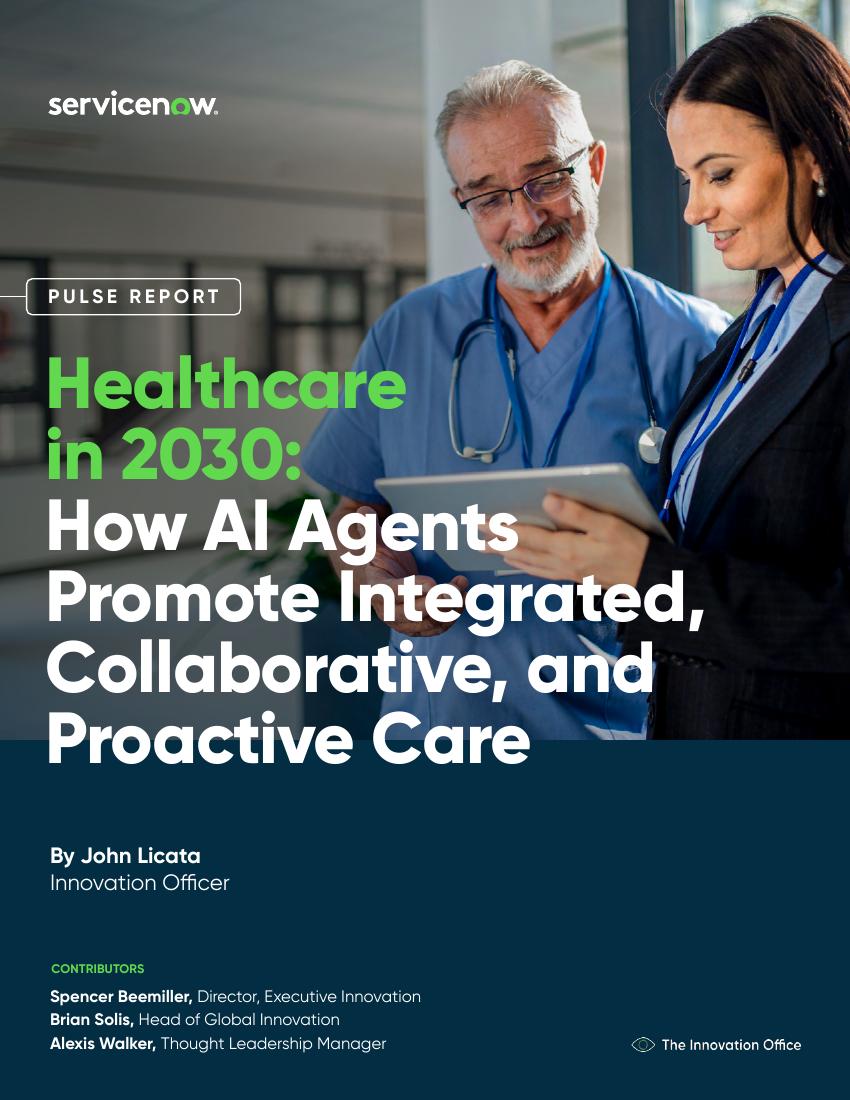
Healthcare in 2030
How AI agents promote integrated, collaborative and proactive care
Healthcare generates roughly a third of the world's data, yet most organizations are being crushed by it rather than transformed by it. AI agents change that equation.
- Authors
John LicataInnovation Officer
Spencer BeemillerDirector, Executive Innovation
Brian SolisHead of Global Innovation
Alexis WalkerThought Leadership Manager
- Length
- 16 pages
- Themes
- The Future of AI, Customer Experience, The Actualized Enterprise
Summary
- Healthcare organizations face challenges from siloed departments and outdated systems, which make it difficult to use growing volumes of data and deliver efficient care.
- The industry sits on the precipice of an AI and agent-driven revolution in which genuine digital and operational transformation reimagines operations, workflows and patient care.
- Over the next five years, AI agents will reshape healthcare in three ways: integration, unifying legacy and modern systems for streamlined workflows; collaboration, connecting systems to support better health outcomes; and proactive care, learning and evolving to create new approaches to prevention.
- Electronic health records created a wealth of data, but legacy technology means most organizations manage that data rather than harness it.
- A unifying platform of data, agents and workflows lets healthcare organizations put AI to work across providers, patients, caregivers, payers and the wider ecosystem.
From the brief
Imagine analyzing the most complex, distributed data across vast ecosystems to forecast possible health events or predict surges in demand — activating mitigation, staffing and supply-chain workflows before the moment arrives.
AI agents will enable an industry-changing shift in services from reactive to proactive, enhancing end-to-end experiences, capabilities and outcomes for providers and the entire health ecosystem.
Read the full report